For Low Cost Car Insurance
833-700-0000Areas We Serve > Louisiana > New Orleans
Louisiana requires every driver, including in New Orleans, to carry at least 15/30/25 liability coverage: $15,000 for bodily injury per person, $30,000 per accident, and $25,000 for property damage. New Orleans premiums run well above the Louisiana state average, as the 2026 figures below show. Storm exposure, claim and litigation costs and uninsured drivers all contribute. Storm and flood damage to a vehicle is paid under comprehensive coverage, not under liability and not under a home flood policy, which is the single most important coverage distinction for a New Orleans driver to understand.


GoAuto can save you money on car insurance, even if you’re a high-risk driver. Here’s how:


New Orleans drivers face a combination that is unusual even for the Gulf Coast: narrow older streets, heavy event and tourist traffic, and repeated storm and flood exposure. All three show up in what coverage costs here.
New Orleans premiums run above the Louisiana state average, and Louisiana itself runs above the national average. These are market averages across all carriers, not GoAuto rates.
| Coverage level | New Orleans | Louisiana average |
|---|---|---|
| State-minimum liability (15/30/25) | $1,968 / year ($164 / month) | $1,187 / year ($99 / month) |
| Full coverage (liability + comprehensive + collision) | $4,548 / year ($379 / month) | $2,827 / year ($236 / month) |
Source: MoneyGeek, “Average Cost of Car Insurance in Louisiana” and its city comparison table, 2026 data, accessed July 29, 2026. Market averages across all carriers only; no individual insurer’s rates are represented. State annual and monthly figures are as published; city annual figures are the published monthly figure multiplied by twelve.
Rates also vary inside the metro. Orleans Parish, Jefferson Parish and St. Bernard Parish are rated separately, so a move across a parish line can change a quote without anything else about the driver changing.
New Orleans concentrates almost every factor that raises an auto premium into one metro:
Yes, but only if you carry comprehensive coverage. This is the coverage distinction New Orleans drivers most often get wrong, so it is worth being precise about:
| Damage | What pays |
|---|---|
| Flood water damage to your vehicle | Comprehensive auto coverage |
| Wind, hail or falling-tree damage to your vehicle | Comprehensive auto coverage |
| Collision during a storm | Collision coverage |
| Damage you cause to someone else | Liability coverage |
| Flood damage to your home and its contents | A separate flood insurance policy, not auto insurance |
Two consequences follow. First, a state-minimum liability policy pays nothing toward storm damage to your own vehicle, because liability covers other people’s losses, not yours. Second, a home or renters flood policy does not extend to a car. Vehicles are covered by auto comprehensive, and only by auto comprehensive.
Two practical notes for the Gulf Coast. Comprehensive carries its own deductible, which applies per claim. And many insurers stop binding new coverage or accepting coverage changes once a named storm enters a defined area, a practice usually called a binding restriction or hurricane moratorium. Adding comprehensive coverage after a storm is named is generally not possible, so the decision is best made before a storm is named rather than after. Current practice varies by carrier; the Louisiana Department of Insurance publishes consumer guidance on storm-season coverage.
New Orleans has no separate city requirement. The Louisiana state minimum applies, usually written as 15/30/25.
| Coverage | Louisiana minimum |
|---|---|
| Bodily injury liability, per person | $15,000 |
| Bodily injury liability, per accident | $30,000 |
| Property damage liability | $25,000 |
Louisiana is an at-fault state, so the driver who causes a crash is responsible for the resulting injuries and damage. Louisiana also has a No Pay, No Play law, which since August 1, 2025 prevents an uninsured driver from recovering the first $100,000 of bodily injury damages and the first $100,000 of property damage, even when another driver was entirely at fault. Those thresholds were raised from $15,000 and $25,000 by Act 16 of the 2025 Regular Session, which amended La. R.S. 32:866. The bar does not apply in every case: under the statute the limitation is lifted where the at-fault driver was convicted of or pleaded no contest to DWI, intentionally caused the crash, fled the scene, or was committing a felony at the time, and it does not apply to a vehicle that was legally parked when it was struck. Further exceptions exist, so check the statute for your own circumstances. Because almost every vehicle is worth less than $100,000, an uninsured driver whose car is destroyed by an at-fault driver will typically recover nothing toward the vehicle. See our Louisiana car insurance page for the complete state breakdown.
Quotes are only comparable when they describe the same policy. Work in this order:
GoAuto Insurance writes auto coverage across its licensed states, including Louisiana, and considers drivers with a range of records, including tickets, accidents, DUIs, and coverage lapses. GoAuto focuses on state-minimum liability coverage, the lowest coverage level the law allows, and can handle SR-22 filing once your policy is active. Down-payment and payment options vary by state and situation. Eligibility, coverage, filing timelines, and pricing depend on your state and your individual circumstances, so the best way to see what applies to you is to get a quote.
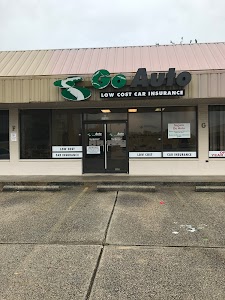
You can also call (504) 254-3000 or visit one of the New Orleans offices listed above. For state-level information, see our Louisiana car insurance page.
No single company is cheapest for every New Orleans driver. Carriers file different rating plans with the Louisiana Department of Insurance and weight parish, ZIP code, driving record, vehicle, coverage history and credit-based insurance score differently, so the carrier that quotes lowest for one driver is frequently not the lowest for the next. In New Orleans specifically, your parish does more work than most drivers expect: Orleans, Jefferson and St. Bernard are rated separately. Fix your coverage level first, then collect quotes at identical limits and deductibles from several carriers using your exact address.
2026 market averages put New Orleans at about $164 per month for state-minimum liability and about $379 per month for full coverage, against Louisiana statewide averages of $99 and $236, according to MoneyGeek, accessed July 29, 2026. Those are averages across all carriers, not a quote. New Orleans full coverage runs roughly 61% above the Louisiana average shown above.
Not consistently. National and regional carriers file separate rating plans with the Louisiana Department of Insurance and weight the same driver differently, so neither group is reliably cheaper. Which is lower depends entirely on the driver being rated. A clean record and a newer vehicle often favor a national carrier; a recent violation or a coverage gap often favors a regional one. Compare the two at identical limits rather than picking a category first.
Work back from what you actually need: review your limits, your deductibles and any optional add-ons, and check your lender’s requirements if the vehicle is financed. Increasing the deductible trims the premium but adds to your cost when you file, so set it only where you could cover the difference. Keeping continuous coverage matters in Louisiana, because most carriers treat a gap in prior insurance as a rating factor. Be careful about dropping comprehensive to save money in a storm-exposed market: it is the only coverage that pays for flood, wind and hail damage to your own vehicle.
Only comprehensive coverage does. Flood, wind and hail damage to a vehicle is paid under comprehensive auto coverage, not under liability and not under a home or renters flood policy, which covers buildings and contents rather than cars. A state-minimum liability policy pays nothing toward storm damage to your own vehicle. Comprehensive also carries its own deductible, and insurers commonly restrict new coverage and coverage changes once a named storm approaches, so the decision is best made before a storm is named rather than after.
Louisiana requires 15/30/25: $15,000 of bodily injury coverage per person, $30,000 per accident, and $25,000 of property damage coverage. That is liability only and pays nothing toward repairing your own vehicle. Louisiana’s No Pay, No Play law also limits what an uninsured driver can recover after a crash someone else caused, and since August 1, 2025 that bar is the first $100,000 of bodily injury and the first $100,000 of property damage, up from $15,000 and $25,000. That change means carrying at least the minimum now affects what a Louisiana driver can recover after a crash someone else caused.
Last updated: July 2026.

The information on this page is general educational content drawn from public industry sources. Specific rate impacts vary by state, by carrier, by individual driving history, and by the rate factors filed and approved with each state Department of Insurance. The figures on this page are third-party market averages from the sources cited, not GoAuto rates or rating factors. For an accurate quote, contact GoAuto directly.