
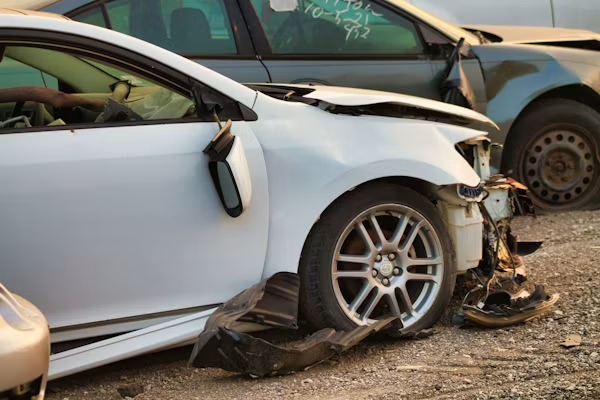
Being dropped or non-renewed still leaves you able to buy car insurance. The reliable path is to compare carriers, including nonstandard insurers that work with higher-risk drivers, give each one accurate details about your history, and start a replacement policy before your current coverage ends so you avoid a lapse. Coverage stays available, and the main task is matching your situation to a carrier that writes it.
This guide explains how being dropped, non-renewed, and canceled differ, since the three terms are often mixed up. It covers the common reasons a carrier ends a policy, why coverage is still available even after a drop, and a step-by-step way to get insured again without a gap. If this applies to you, the same basic steps hold wherever you live.
Key Takeaways
- Being dropped or non-renewed still leaves you able to buy car insurance, often through nonstandard carriers that work with higher-risk drivers.
- A cancellation ends a policy before its scheduled end date, while a non-renewal lets the policy finish its full term before the insurer declines to offer another.
- After an early window, often the first 60 days, an insurer can usually cancel only for limited causes such as nonpayment or a material misstatement.
- Some non-renewals reflect a carrier’s business decisions, so even drivers with clean records can be dropped when a company leaves a state or tightens its underwriting.
- NerdWallet’s August 2026 analysis put the national average near $2,356 a year for full coverage and $646 a year for minimum coverage, and a dropped driver’s quotes can sit above those figures.
- Starting a replacement policy before the old one ends avoids a coverage lapse, which is a separate cost from the drop itself.
Dropped vs Non-Renewed vs Canceled
People use dropped, non-renewed, and canceled as if they mean the same thing, but they describe different events. A cancellation stops a policy before its scheduled end date, and either you or the insurer can trigger one. According to the National Association of Insurance Commissioners’ Consumer’s Guide to Auto Insurance (2022), a company can usually cancel a brand-new policy for a wide set of reasons during an early window, often the first 60 days, and after that window it can cancel only for limited causes such as nonpayment of premium or a material misstatement on your application.
A non-renewal works differently. Here, the insurer honors the policy through its full term, then declines to offer another term when it expires. The coverage you paid for stays in force to the end date, and the carrier simply chooses not to continue past it. The NAIC guide notes that insurers generally have the right to non-renew, but they must send advance written notice and, in many states, explain the reason.
“Dropped” is an informal word rather than a legal one. When people say they were dropped, they usually mean either a mid-term cancellation or a non-renewal at the end of the term. The distinction matters because it sets your timeline. A cancellation can leave you without coverage on short notice, while a non-renewal gives you until the expiration date to line up a replacement. Read the notice your insurer sent, because it states which action was taken, the effective date, and how much time you have. That date sets the deadline for putting a new policy in place.
Why Insurers Drop or Non-Renew a Policy
Carriers end policies for reasons that fall into a few groups. The most common is risk tied to your record. A series of at-fault accidents, several claims in a short span, or serious moving violations can move you into a category a standard insurer chooses to stop writing. The Insurance Information Institute lists your driving record among the core factors that determine what you pay, and a rough stretch there can lead a standard insurer to stop writing your policy.
Payment and paperwork make up the next group. Missing premium payments is a frequent cause of mid-term cancellation, and a material error or omission on your application can void the policy. A lapse in prior coverage, a suspended license, or an unpaid balance can each prompt a carrier to step away as well.
The last group has little to do with you personally. Insurers make business decisions about where and what they write. A company may pull out of a state, stop writing a class of vehicle, or tighten its underwriting after a costly year of losses. When that happens, even drivers with clean records can receive a non-renewal notice. A drop can reflect the carrier’s own strategy rather than your record alone.
Whatever the cause, the notice you receive should state the reason. Knowing which group you fall into helps you shop, because a clean-record driver dropped for a business reason will approach the market differently from a driver rebuilding after several claims. A driver in the second situation may lean toward nonstandard carriers from the start, while a clean-record driver dropped for a business reason can often find a standard company that still writes their profile.
Step-by-Step: Getting Insured Again
Getting covered again is a sequence of practical steps. Move through them in order and start early, because the clock is set by the date on your notice.
- Read the notice and mark the date. Whether you were canceled or non-renewed, the letter states the exact date your coverage ends. That date is your deadline for having a new policy in force.
- Begin comparing carriers as soon as you get the notice. Gather quotes from several companies, and include nonstandard insurers, which specialize in drivers who fall outside standard underwriting. Prices vary widely by carrier: NerdWallet’s August 2026 analysis put the national average near $2,356 a year for full coverage and $646 a year for minimum coverage, and a dropped driver’s quotes can sit above those averages.
- Have your details ready and keep them accurate. You will need your license, the vehicle identification number, your prior policy information, and an honest account of any accidents or violations. Accurate information protects the new policy, since a misstatement is itself a reason a carrier can cancel later.
- Bind the new policy before the old one ends. Set the new coverage to start on or before your end date so the two overlap by a day rather than leaving a gap. If a renewal or reinstatement of your existing policy is still on the table, our guide on keeping coverage on track walks through that route.
- Confirm and keep proof. Once the policy is active, save your declarations page and proof of insurance. If you are unsure whether a quote fits your situation, you can contact GoAuto to talk it through before you buy.
What to Avoid While You Shop
A few missteps can make a hard situation harder, so keep these in mind while you shop.
First, keep driving legal. Every state GoAuto serves requires at least minimum liability coverage to drive, and driving without it can bring fines, license suspension, and steeper insurance costs later. Staying insured through the transition matters more than the inconvenience of arranging it under time pressure. Do not drive uninsured while you sort out a new policy.
Second, avoid a coverage gap. Insurers treat a lapse as a risk signal, and even a short break between policies can raise the price of your next one. That is a separate cost from the drop itself, and it is one you can control by lining up new coverage before the old policy ends. If you need a stopgap while you settle a longer-term policy, our overview of short-term car insurance explains how brief coverage works and when it fits.
Third, keep your account honest. It can be tempting to leave off a recent claim or violation to get a lower number, but a misstatement gives the new carrier grounds to cancel the policy later, which puts you right back where you started.
Fourth, compare before you commit, and still respect the deadline. Standard and nonstandard carriers price the same record very differently, so a few quotes are worth the effort. At the same time, let the expiration date guide you: line up the new policy first, then keep comparing at renewal if you want to. The goal is continuous coverage with terms you can live with, not the first or the last quote you happen to see.
The takeaway is that being dropped or non-renewed is a setback rather than a dead end. Nonstandard carriers exist precisely for drivers in this position, and the mark on your record fades with time. Move quickly, keep your information accurate, compare a few options at the same coverage, and avoid any gap while you shop. Do that, and you can be insured again without the situation following you longer than it needs to.
It also helps to use the reason on your notice to shape how you shop. If the policy ended over missed payments, showing that you can keep up with a payment plan, or setting up automatic payments, can make a difference with the next carrier. If it ended because of your record, focusing first on nonstandard carriers that expect a rougher history tends to save time. And if it ended for a business reason that has nothing to do with you, a standard company may still write your profile, so it is worth starting there before assuming you need a higher-risk policy. Matching your approach to the actual reason keeps you from paying more than your situation calls for, and it makes each quote you gather more useful. None of this changes the basic fact that coverage remains available after a drop, but it does help you reach it faster and at a price that fits your situation.
Frequently Asked Questions
What is the difference between being canceled and non-renewed?
A cancellation ends a policy before its scheduled end date, often for nonpayment or a misstatement once the early new-policy window has passed. A non-renewal lets the policy finish its full term, then declines to offer a new one. Both require advance written notice from the insurer.
Can I still get car insurance after being dropped?
Yes. Coverage is available from other carriers, including nonstandard insurers that write higher-risk drivers. Shop several companies, provide accurate details about your history, and start the new policy before your current one ends so you avoid a lapse.
Why did my insurer non-renew me when my record is clean?
Non-renewals sometimes reflect a carrier’s business decisions rather than your record. An insurer may leave a state, stop writing a vehicle class, or tighten its underwriting after a costly year, so drivers with clean records can be non-renewed as well. The notice you receive should give the specific reason.
How do I avoid a lapse in coverage?
Set your new policy to begin on or before the day your current coverage ends, so the two overlap instead of leaving a gap. A lapse can raise your next premium, and in every state GoAuto serves, driving uninsured is against the law. If you need a bridge, short-term coverage can hold the space while you finish shopping.
About GoAuto
GoAuto Insurance writes auto coverage across its licensed states, with a focus on the state-minimum liability coverage that drivers are required to carry. Because what applies to you depends on your state, your record, and your individual situation, the reliable way to see your options and what they cost is to get a quote. You can start a policy or ask questions about your coverage directly with GoAuto.
Sources
- National Association of Insurance Commissioners, A Consumer’s Guide to Auto Insurance (2022)
- Insurance Information Institute, What Determines the Price of My Auto Insurance Policy?
- NerdWallet, Average Car Insurance Cost (August 2026)