

For Low Cost Car Insurance
833-700-0000Areas We Serve > Georgia
Georgia requires every registered vehicle to carry at least 25/50/25 liability coverage: $25,000 for bodily injury per person, $50,000 per accident, and $25,000 for property damage. Georgia is an at-fault state, so the driver who causes a crash is responsible for the resulting injuries and damage, and coverage is verified electronically against your vehicle registration rather than by paper proof alone. What a Georgia driver pays varies widely by county, vehicle, driving record and coverage level, which is why quotes at identical limits are the only meaningful comparison.
GoAuto can save you money on car insurance, even if you’re a high-risk driver. Here’s how:





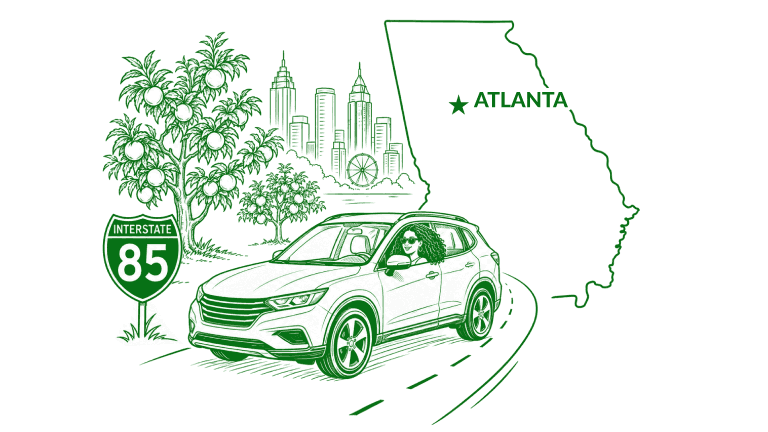
With busy metros like Atlanta and long rural stretches in between, what Georgia drivers pay for coverage varies more by where they live than by almost anything else.
The table below shows 2026 market averages for Georgia at each coverage level, alongside Atlanta, the state’s largest city. These are market averages across all carriers, not GoAuto rates, and no average will match an individual quote.
| Coverage level | Georgia average | Atlanta |
|---|---|---|
| State-minimum liability (25/50/25) | $1,030 / year ($86 / month) | $1,308 / year ($109 / month) |
| Full coverage (liability + comprehensive + collision) | $1,788 / year ($149 / month) | $2,244 / year ($187 / month) |
Source: MoneyGeek, “Average Cost of Car Insurance in Georgia” and its city comparison table, 2026 data, accessed July 29, 2026. Market averages only; no individual insurer’s rates are represented.
Rates also vary substantially inside Georgia. Atlanta runs above the Georgia average at both coverage levels, at about $109 and $187 per month against $86 and $149 statewide. Traffic density, claim frequency and repair costs are rated differently across the state. See our Atlanta car insurance page for city-level detail.
Georgia law requires every registered vehicle to carry at least the liability limits below, usually written as 25/50/25. You may buy higher limits, and many drivers do.
| Coverage | Georgia minimum |
|---|---|
| Bodily injury liability, per person | $25,000 |
| Bodily injury liability, per accident | $50,000 |
| Property damage liability | $25,000 |
Liability coverage pays for injuries and property damage you cause to other people. It pays nothing toward repairing your own vehicle. For that you need physical damage coverage, which comes in two parts: collision, which covers damage from a crash regardless of fault, and comprehensive, sometimes called other-than-collision, which covers theft, vandalism, fire, falling objects and weather damage. Georgia does not require physical damage coverage, but if your vehicle is financed or leased the lender almost always will. You may file a claim under your own physical damage coverage even when another driver caused the accident.
Georgia insurers must also offer uninsured and underinsured motorist coverage, which pays when the at-fault driver has no insurance or not enough. You may decline it, but the rejection has to be in writing. For official guidance on state requirements and registration, see the Georgia Department of Driver Services.
Yes. Every vehicle registered in Georgia must carry at least 25/50/25 liability coverage, and Georgia is an at-fault, or tort, state rather than a no-fault state. That means the driver responsible for a crash is responsible for the resulting injuries and property damage, and their liability coverage pays those costs first.
Georgia verifies coverage electronically. Insurers report policy activity directly to the state through the Georgia Electronic Insurance Compliance System, which matches coverage against vehicle registration records, so a lapse is flagged automatically rather than at a traffic stop. When coverage lapses, the state can suspend the vehicle registration, and restoring it requires new coverage plus a lapse fee and a reinstatement fee. Current fee amounts are published by the Georgia Department of Driver Services. Driving an uninsured vehicle in Georgia can also lead to fines, license suspension, and in some circumstances an SR-22 filing requirement before driving privileges are restored.
Practical consequence: if you sell a vehicle or take one off the road, cancel the registration as well as the policy. A canceled policy on a still-registered vehicle is what generates most Georgia lapse notices.
Georgia insurers file their rating plans with the Georgia Office of Commissioner of Insurance and Safety Fire, and the factors they weight most heavily are consistent across carriers even though the weightings differ:
Georgia’s minimum is liability only, so it will not repair your own car and will not protect you against an uninsured driver. If your vehicle is financed or leased, your lender will normally require collision and comprehensive on top of the state minimum.

GoAuto Insurance writes auto coverage across its licensed states, including Georgia, and considers drivers with a range of records, including tickets, accidents, DUIs, and coverage lapses. GoAuto focuses on state-minimum liability coverage, the lowest coverage level the law allows, and can handle SR-22 filing once your policy is active. Down-payment and payment options vary by state and situation. Eligibility, coverage, filing timelines, and pricing depend on your state and your individual circumstances, so the best way to see what applies to you is to get a quote.
You can also call (833) 700-0000.
No single company is cheapest for every Georgia driver. Carriers file different rating plans with the state and weight county, driving record, vehicle, annual mileage, coverage history and credit-based insurance score differently, so the carrier that quotes lowest for one driver frequently is not the lowest for the next. The reliable method is to decide your coverage level first, then collect quotes at identical limits and deductibles from several carriers, including both national and regional insurers. Where you live inside Georgia will usually move your quote more than which brand you pick.
2026 market averages put Georgia at about $86 per month for state-minimum liability and about $149 per month for full coverage, according to MoneyGeek’s Georgia analysis, accessed July 29, 2026. Those are averages across all carriers, not a quote. Atlanta runs above the Georgia average, at about $109 and $187 per month.
Not consistently. National and regional carriers file separate rating plans with the Georgia Office of Commissioner of Insurance and Safety Fire and weight the same driver differently, so neither group is reliably cheaper. Which one comes out ahead depends on the driver being rated. A newer vehicle and a clean record tend to favor a national carrier; a recent violation or a coverage gap tends to favor a regional one. Get both priced at identical limits before ruling either out.
Start by matching the policy to what you actually need: review your limits, deductibles and optional add-ons, and check what your lender requires if the vehicle is financed. A higher deductible reduces the premium but raises your out-of-pocket cost at claim time, so set it at a figure you could actually cover. A clean driving record matters most over time, since violations and at-fault accidents typically affect a Georgia rate for three to five years. Ask each carrier which discounts you qualify for, and re-shop when your vehicle, address or record changes.
Georgia requires 25/50/25: $25,000 of bodily injury coverage per person, $50,000 per accident, and $25,000 of property damage coverage. That is liability only. It pays for injuries and damage you cause to others and pays nothing toward repairing your own vehicle.
Georgia insurers report coverage electronically to the state, so a lapse is identified automatically against your vehicle registration. The state can suspend the registration, and restoring it requires new coverage plus a lapse fee and a reinstatement fee, with current amounts published by the Georgia Department of Driver Services. Driving an uninsured vehicle can also lead to fines and license suspension. If you take a vehicle off the road, cancel the registration as well as the policy, because a canceled policy on a registered vehicle is what triggers most lapse notices.