

1. Introduction
You’re driving through a quiet neighborhood, maybe five miles below the speed limit, when a patrol car pulls you over for a broken tail light. The officer asks you for your driver’s license, and when you hand it over, it’s expired. That small slip-up could cost you more than just a ticket.
The direct answer is clear: No, you cannot legally drive with an expired license in the U.S. Driving with an expired license is illegal in every state. There are a few narrow and unusual exceptions; some states may offer brief grace periods (e.g. 30–60 days past expiration), but relying on such a window is risky and not guaranteed.
In this article, we’ll walk through:
- Legal consequences (varies by state)
- The clear distinction between expired vs. suspended/revoked
- Insurance risks and financial fallout
- A call to action: how to avoid getting stuck with expensive penalties
2. Legal Consequences: State-by-State Variations
Classification of the Offense
- In many states, a first offense for driving with a recently expired license is treated as a traffic infraction (i.e. noncriminal).
- But if the license has been expired for a long time, or if there are repeat violations, the offense may be elevated to a misdemeanor or even carry criminal consequences.
Punishment Breakdown
Fines & Tickets
- Typical fines can range from $25 to $250 or more.
- The longer your license has been expired, the steeper the fine may go. Some states impose escalating penalties beyond 60 days or six months.
- In Illinois, for example, fines for driving with an expired license can reach up to $1,000 in extreme cases.
Points on Your Record
- Some states may treat the violation as a non-moving violation (no points), but others will add points to your record, raising your standing as a “higher risk” driver.
Jail Time / Misdemeanor
- In states where the offense is elevated, you could face jail up to 30 days or more and a criminal record.
- California, for instance, treats driving without a valid license (including expired) as a “wobbler” – it can be an infraction or misdemeanor. If charged as a misdemeanor, penalties can be up to 6 months in jail and a $1,000 fine.
Vehicle Impoundment
- In some jurisdictions, especially for repeated violations, the officer may impound your vehicle until you resolve the licensing issue.
Note: These are sample states and circumstances. Laws vary widely, so you must check your state’s DMV or transportation agency for exact rules.
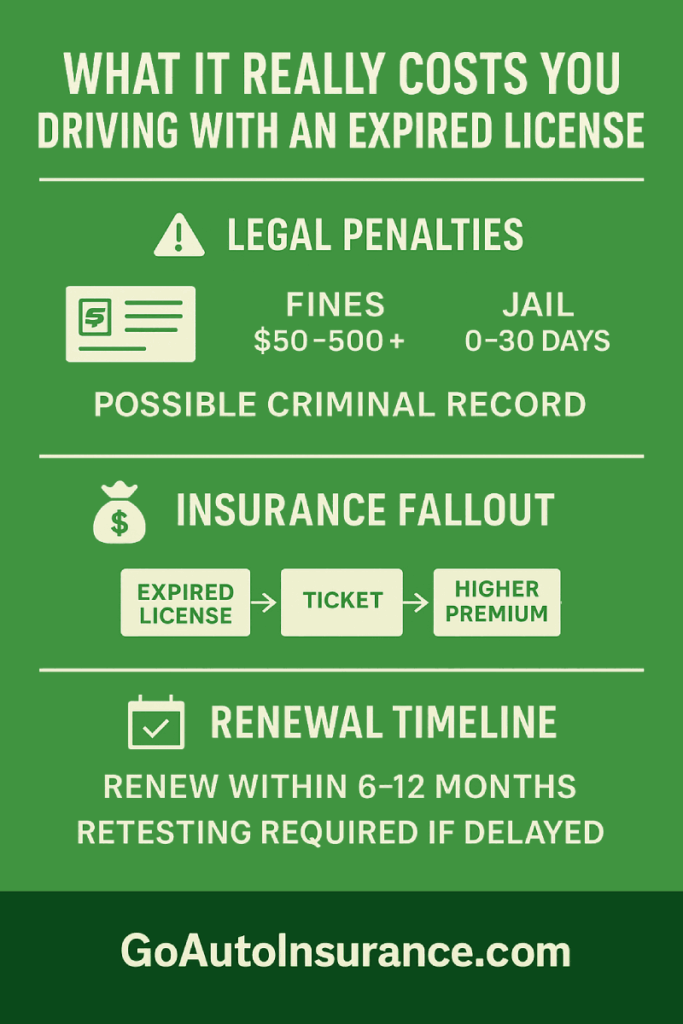
*This infographic summarizes the key consequences of driving with an expired license across the U.S. – from state fines and possible jail time to insurance premium hikes and renewal deadlines. It provides a quick visual overview of why renewing your license on time is essential to avoid costly penalties and long-term financial risks.
3. The Crucial Difference: Expired vs. Suspended/Revoked
What’s the difference?
- Expired license means your permission to drive has lapsed because you didn’t renew it on time.
- Suspended or revoked license means the state has actively taken away your driving privileges, typically due to violations, court orders, DUI, or other serious infractions.
Why it matters
- Driving on a suspended or revoked license is far more serious. In nearly all states, it is a misdemeanor or even felony, with higher fines, mandatory jail time, and longer re-ineligibility periods.
- An expired license might allow for a “fix-it” or reduced consequence if you promptly correct it. Conversely, suspension/revocation usually does not.
- In court, defense strategies differ significantly depending on whether a license is merely expired versus suspended.
4. Call to Action & Prevention
Renewal is Key
- Don’t wait. Check your license’s expiration immediately.
- Many states offer online or mail-in renewal options. Do it well before your expiration date, if possible.
Watch for Late Renewal Rules
- If your license has been expired for too long, often 6 months to a year, depending on your state, you may incur late fees and you may also be required to retake:
- The written test
- The vision screening
- Potentially the road test
What to Do If You Are Stopped
- Be polite and cooperative. Explain that your license expired and show intent to renew.
- In many places, officers may offer a “fix-it” ticket – a reduced or invalidated charge if you renew your license and present proof.
- Always bring proof of renewal (receipt, temporary paper license, etc.) to court if needed.
5. Key Takeaways
- Driving with an expired license is illegal in all 50 U.S. states.
- Penalties escalate with time and repeated offenses (fines, points, jail, impoundment).
- Expired ≠ suspended, and the legal distinction changes how serious the offense is.
- Insurance claims may be denied if you’re driving illegally, leaving you fully liable for costs.
- Proactively renew your license before it expires to avoid this entire set of risks.
Sources:
Nolo Legal Portal
Zutobi Driver Education resource
https://zutobi.com/us/driver-guides/driving-with-expired-drivers-license
I Drive Safely Blog